
The Values on a Kalkaska County Property Record
Kalkaska County assessment records label value in several ways. Each measure carries its own legal meaning. Michigan law treats true cash value as a usual-selling-price concept, and assessed value generally sits at 50 percent of that figure. Taxable value follows its own capped path under statute, and a transfer can uncap it.
| Value | What It Is | Where |
|---|---|---|
| Assessed value | Local assessment before equalization | BS&A assessment record |
| State equalized value | Equalized assessment, generally 50% of TCV | Assessment record and notice |
| Taxable value | The capped base used in the tax calculation | Assessment and tax record |
| Last sale price | Reported consideration or sale-history clue | Deed index or assessment history |
| Land and improvement | Separate components of the assessment analysis | Detailed parcel record |
Collapsing these fields into one figure invites error. A recorded sale is not always arm's length. It may be nominal, related-party, or an auction amount, and an assessment serves public taxation rather than one buyer's financing decision. The county Equalization page is the official value and GIS gateway.
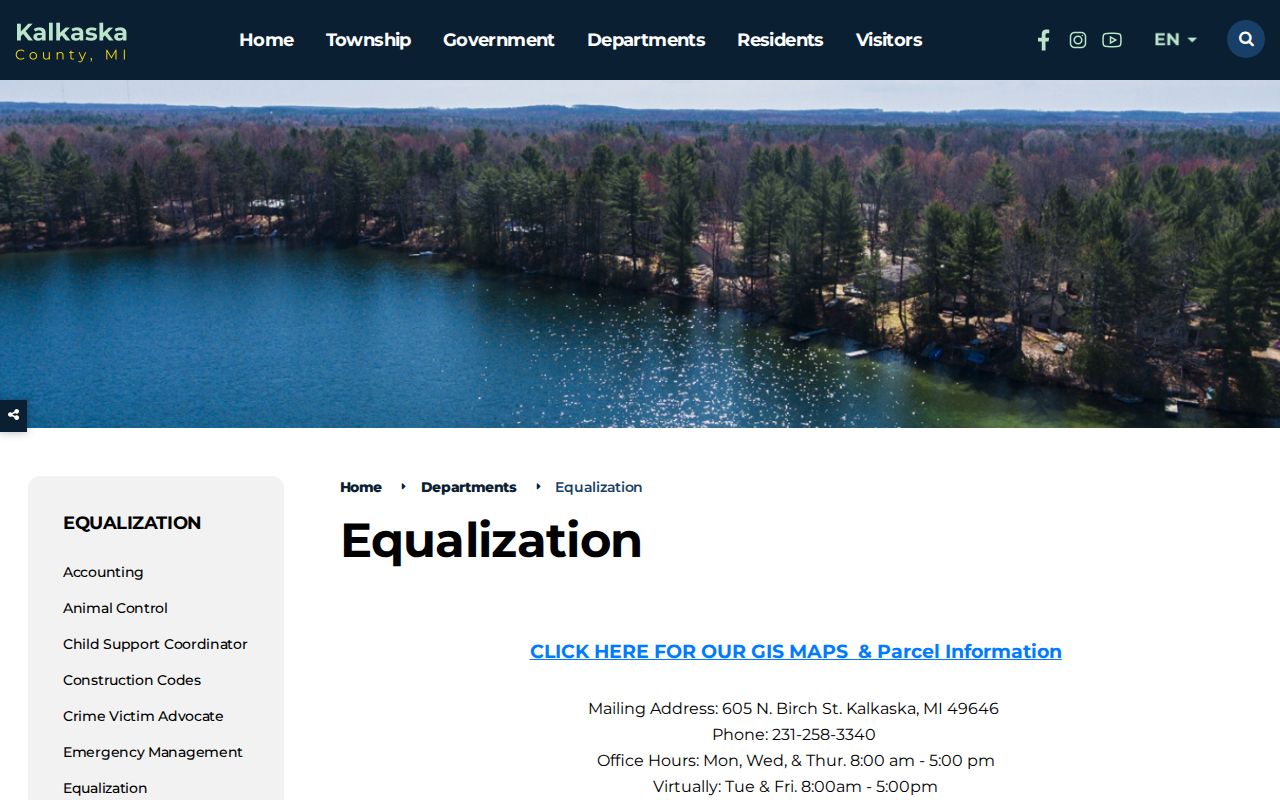
The Equalization page names the office; BS&A shows current value.
Looking Up a Kalkaska County Property Value
Use the Kalkaska County Equalization gateway to reach BS&A. The portal supports address, name, and parcel search routes. Field availability varies by result.
- Search the address, then confirm the parcel number, unit, class, and legal description.
- Record AV, SEV, taxable value, land, improvement, PRE or exemption, and tax year as separate fields.
- Inspect the sale history and confirm a relevant transfer against the recorded instrument.
- Explain changes through cap, uncapping, classification, physical work, or revaluation before drawing conclusions.
- True cash value
- Michigan's statutory usual-selling-price concept, subject to legal exclusions.
- Assessed value
- The local assessment before equalization, not taxable value.
- State equalized value
- The assessment after county and state equalization.
- Taxable value
- The capped value used to calculate tax before millage and charges.
Michigan's Fifty Percent Framework
MCL 211.27 defines true cash value through usual selling price. Auction and forced prices cannot stand alone as evidence. State equalized value generally reflects half of true cash value. Doubling a card field guarantees nothing. Mass assessment draws on property groups, classifications, physical data, and sales evidence. A real transaction turns on the parties. The date, condition, and terms of the sale matter just as much.
Why Kalkaska Taxable Value Differs
Michigan taxable value often sits below state equalized value. The cap explains why. Annual growth is limited under the General Property Tax Act. A transfer can uncap taxable value in the following calendar year unless an exclusion applies. A sharp jump may just be uncapping. Record the transfer or last-name-change date, PRE status, and surrounding tax years, and the Michigan Treasury ownership-change resource explains the state framework.
Test Kalkaska Sale Prices Carefully
Start with BS&A's Property Sale Search. It filters by date, price, and class. Treat those results as leads, then weigh parcel size, class, land and improvement mix, sale type, and recording evidence. Foreclosure and tax-sale notices are not completed sales. Confirm the final deed and circumstances before counting a distressed, non-arm's-length amount as market proof.
One Village Card Is Not a Trend
One Village commercial card shows values across several years. A single parcel proves little. It cannot establish a Kalkaska County or Village market trend. A sound sample pulls several comparable cards from the same unit, class, period, and property type. It separates transfers and uncapping from true market movement while recording land, improvement, PRE, and sale-history fields. ZIP 49646 alone does not prove Village jurisdiction.
Exemptions Alter the Tax Base
Exemptions alter the tax base. PRE, veteran, forest, and other exemption or deferment fields can affect tax treatment without changing what the open market might pay. Keep each label beside taxable value. The Kalkaska County Treasurer links exemption, transfer, calendar, and tax resources. Detailed tax bills and appeal procedure belong with the property tax record. Value fields carry their own meaning.
Build a Kalkaska Value Worksheet
Build the worksheet one row per tax year. Give each field its own column. Record the parcel, assessment unit, class, year, assessed value, state equalized value, taxable value, land, improvement, PRE or exemption status, transfer or last-name-change date, and any sale history. Keep blanks visible rather than shifting numbers across columns. A value never moves just because its label is missing or two figures happen to match.
| Field | Question it answers | Context to retain |
|---|---|---|
| AV and SEV | What assessment and equalization figures apply? | Tax year, class, unit |
| Taxable value | What capped base applies? | Transfer, cap, exemption |
| Land and improvement | How is the assessment split? | Physical data and year |
| Sale amount | What consideration was reported? | Instrument and sale type |
Compare several years only after confirming the parcel stayed comparable. Watch for changes first. A split, combination, or new building can break a simple year-to-year series. So can demolition, class change, exemption change, or corrected data. Taxable value may uncap after a transfer. Assessed and equalized values can move through revaluation and equalization without a sale. Each cause carries a different meaning.
Sale history needs equal care. Note the sale date, price or consideration, seller and buyer when shown, instrument reference, and classification. Identify a family, entity, foreclosure, auction, nominal, or otherwise non-arm's-length event before using it as market evidence. Michigan law bars a shortcut here. A forced or auction price cannot stand as the sole controlling proof of true cash value.
For comparison parcels, hold several factors steady. Keep property class, location, size, land and improvement mix, and period as steady as the available record permits. A countywide median, a Village commercial parcel, and a rural residential tract do not answer the same question. The public assessment card may help frame a comparison. It is not a broker opinion or appraisal report.
The county Equalization office can address assessment and parcel-data questions. The local assessor handles property-level assessment work. The Register of Deeds handles instrument data, while the Treasurer handles bills and balances. Sending the exact parcel, year, and field label gives the office a clear issue to review.
Use the assessment notice and current official sources for time-sensitive figures. A saved copy documents what a source showed on a date, but it will not update itself. The figure may matter to a sale, estate, appeal, or financing choice. Then obtain the current record and qualified advice. Do not rely on an old card.
The final statement should name the measure. Use “2025 taxable value shown by BS&A,” for example. Do not write “the home is worth.” Precise labels keep public tax data from becoming a false market promise.
What a Kalkaska County Assessor Value Is Not
A Kalkaska County assessed value is a mass-assessment figure built for public taxation. It can lag a fast-moving market. And it may reflect a data correction, classification shift, improvement, equalization, cap, or transfer rather than what a buyer would actually pay.
Value is not price. A Kalkaska County assessed value is not a sale prediction or appraisal. Obtain qualified appraisal and title help for a transaction.
Preserve uncertainty. Terms like “not displayed,” “not found,” and “not publicly available” describe different record states and should never be merged.