
What the Kalkaska County Current Owner Record Shows
BS&A puts the assessment owner or taxpayer next to the mailing and situs addresses, the parcel reference, unit, legal description, value fields, and sale history. Read the labels closely. Note the year as well. The name shown for assessment purposes may trail a freshly recorded deed or differ from the tax contact.
| Displayed owner or taxpayer | The role and name printed on the assessment card |
|---|---|
| Mailing address | The notice destination, which may be a business or post office box |
| Situs address | The assigned location of the parcel |
| Parcel and unit | The key joining assessment, map, tax, and deed research |
| Legal description | The land description used to test whether records match |
| Data year and sale history | Timing clues, not proof of complete title |
A current-owner label never tells you who lives there. The mailing line helps with parcel notices, but it can belong to an agent, a trust, an estate, or a company, and it should never be merged with the situs line. The Kalkaska BS&A gateway lists the services that start a current-owner check.
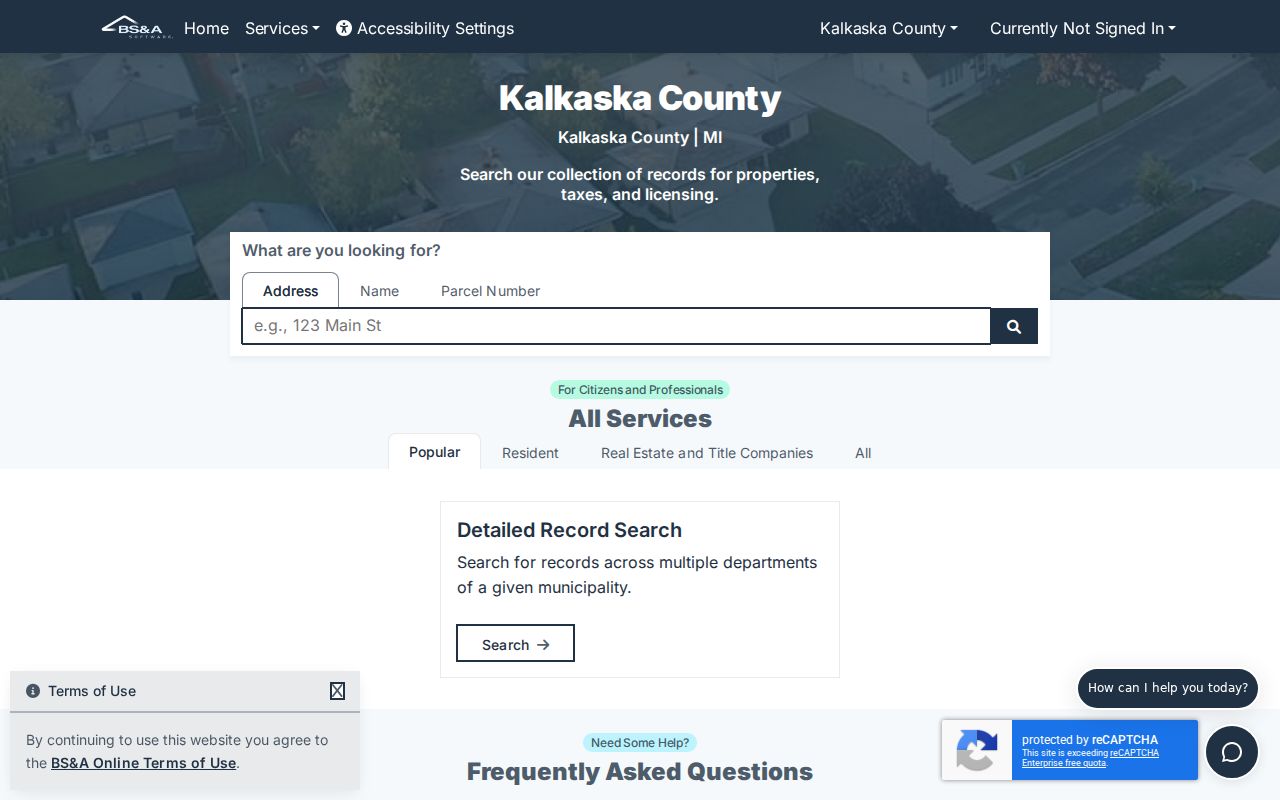
The gateway page is only an entry point. It is not a live parcel result. A current name still requires a fresh search plus deed confirmation.
Confirming the Current Owner in Kalkaska County
Begin at the Kalkaska County Equalization gateway. Then confirm the displayed owner against the newest relevant instrument. The Register of Deeds links Tapestry and cites online homeowner coverage from May 20, 1992 to current.
- Copy the assessment name, parcel, unit, legal description, and tax year.
- Search Tapestry by name, parcel, or legal description for the newest relevant entry.
- Compare grantee, recording date, document type, and full land description.
- Record any mismatch and ask the office responsible for that field.
- Owner of record
- The party a stated record identifies as owner on its stated date.
- Vesting
- The way an instrument states that an interest is held.
- Registered agent
- An entity contact, not automatically the landowner as an individual.
Check Kalkaska Assessment Timing
Record the tax year and any as-of date attached to the owner field. The county publishes no refresh schedule. The screen should not be treated as same-day title data. Michigan assessment records follow an annual cycle. Deeds, by contrast, get recorded all year long. A sale, probate transfer, parcel split, or correction can hit the deed index first. The assessment card may catch up later. Leave blank and unavailable fields blank. For a fresh conveyance, ask Equalization about the roll. Also ask the Register about the instrument.
Resolve Kalkaska Owner Mismatches
BS&A and a deed sometimes disagree. First prove both records describe the same parcel and legal description. Look for a recent filing, a partial conveyance, a life estate, or a probate instrument. A split or a changed parcel format can also explain the mismatch. A similar name alone proves nothing. Assessment-field errors belong with the local assessor or Equalization. Index and instrument issues go to the Register of Deeds. Tax-balance and foreclosure questions sit with the Treasurer. Always include the parcel number and a saved record view.
Verify Kalkaska Entity Owners
Copy the exact LLC, trust, or estate name when checking the current owner. Michigan's MiBusiness Registry Portal verifies an entity name, its status, and the registered-office record. It cannot prove who beneficially owns the land. Search trustee, personal-representative, estate, and decedent variants when those captions appear. Probate may explain authority. But the recorded deed tied to the legal description remains the property link.
Unit 041 and Village Ownership
Village of Kalkaska examples carry a 041 unit prefix, though some DDA references drop it. Keep both the raw and full parcel formats. ZIP 49646 also reaches beyond the incorporated Village. Confirm the unit and Colligo geometry before crediting a current-owner result to the Village.
Note: The sole incorporated municipality has its own Village of Kalkaska records page.
Document the Current Owner Check
A current-owner result carries weight when another reader can repeat it. Save the raw search term and the normalized address variant. Record the parcel or reference number, the assessment unit, and the exact owner or taxpayer label. Note the situs, mailing address, legal description, tax year, and retrieval date. Add the newest relevant deed's grantee, grantor, recording date, instrument type, and book/page or instrument number. Mark any field that is blank, gated, or not exposed by the live county project. Work through every detailed-record tab in order. Summary and owner fields establish the displayed role. Land and legal-description fields confirm identity. Sale history points toward the latest transfer, while building and map tabs add context. A collapsed tab has not been searched just because its label shows. If BS&A offers a "claim property" option, treat it as an account convenience. Never treat it as proof that the claimant is the current owner. Compare names without flattening them. Keep the punctuation inside an LLC name. Keep the initials in a personal name, trust suffixes, estate captions, joint-owner lines, and married-name variants. A unique company name still needs a deed match. A common surname needs parcel and legal-description support. An owner-wide search can return several cards, so review every page instead of assuming the first card is the only parcel. Describe the current owner with a source and date. Cite the assessment owner for a stated tax year. Cite the grantee on a stated instrument, or the taxpayer on a stated bill. That phrasing beats saying someone "owns now" off a name-only hit. If the result affects a purchase, easement, estate, or dispute, request a certified instrument or professional title work.
| Identity key | Parcel, unit, legal description, and situs |
|---|---|
| Current roll evidence | Exact owner or taxpayer label, year, and retrieval date |
| Recorded evidence | Newest matching instrument and grantee |
| Unresolved issue | Mismatch, blank field, access gate, split, or timing concern |
Keep any saved record limited to public land facts. Payment details, private contact information, signatures, and identity documents have no place in an owner-of-record file, and neither does an address the custodian has withheld. The leanest version that still works contains one exact property search, the parcel number, the owner field, the legal description, the record year, and a cross-reference to the deed or map. Anything beyond that adds risk without adding proof.
Kalkaska Current-Owner Fallbacks
An online property search is only one channel among several. A parcel card can show a confusing data year or an odd address assignment. It can also raise an assessment-unit question. Equalization and the local assessor are the right desks to call. The Register of Deeds counter can help you locate the newest matching instrument. It can also dig up an older index entry. Tax questions belong to the Treasurer, whether the bill is current or delinquent. If the county record you need is not posted online, a focused Michigan FOIA request can name the parcel and the record series. The request can also cover the date range and your preferred delivery format. A public notice is never the final owner-of-record answer on its own. Neither is a sale-history row. A foreclosure notice marks a stage in a process, not a completed transfer of title. An estate file can show who holds authority without recording the actual vesting deed. The safe habit is simple. Take the document number or legal description back to Tapestry. Confirm the deed or other instrument it points to. That one extra step keeps pending events sorted into their proper order. It does the same for noticed events and completed transfers.
Reaching a Kalkaska County Property Owner
The public mailing field on a parcel record can be a workable route for a parcel-related letter. Still, treat it as a clue rather than a confirmation. It may lead to an office. It could be a post office box, a former address, or a protected substitute address. Michigan's Address Confidentiality Program provides substitute-address and mail-forwarding protection for qualifying participants. So the listed address is not always a residence.
Lawful use. Use Kalkaska County current-owner information only for legitimate property matters. Never use a public name or address to stalk, harass, intimidate, or harm anyone.
For a disputed interest, a legal notice, or a purchase, rely on professional title and legal channels instead. A public mailing address proves nothing about where the owner of record actually lives.