
Inside Kalkaska Property Tax Records
Kalkaska County keeps tax information in two separate systems. One handles assessment. One handles collection. The Equalization Department ties the countywide assessment tools together and points to local assessor contacts. BS&A Online supplies the Detailed Record, Assessing, Current Tax, Delinquent Tax, and Property Sale services. The County Treasurer, meanwhile, runs collection and the foreclosure side. Read the pieces side by side. That habit prevents a common mistake. It stops you from reading an assessment figure as a bill balance. It also stops you from mistaking a taxpayer name for proof of title.
| Tax field | Meaning in the record | Official route |
|---|---|---|
| Assessed value and SEV | The roll value and state-equalized value for a stated year | BS&A and the local assessor |
| Taxable value | The capped figure to which tax rates are applied | Assessment record and tax detail |
| PRE or exemption | The exemption status displayed for the parcel and year | Assessment record and assessor forms |
| Current tax | Current-year charge, balance, and payment information when available | BS&A Current Tax and Treasurer |
| Delinquent tax | Past-due year, balance, notice, or foreclosure stage | BS&A Delinquent Tax and Treasurer |
Labels matter when reading a tax bill. Michigan generally sets assessed value at half of true cash value. Taxable value can sit lower, since statutory caps hold it down over the years. A transfer of ownership often uncaps that taxable value in the next calendar year. The number can jump after a sale.
Sale price is a separate field altogether. A distressed sale or a transfer between family members may not reflect the open market. Such a sale may not show what a parcel would fetch. The property value page breaks these value types apart. It does not collapse them into one estimate.
Kalkaska Tax Search Fields
For most people, the practical entry point is the Kalkaska County BS&A gateway. You can set the search focus to assessing or tax data. From there, narrow it by address, owner name, or parcel number. An account is generally not needed for a basic search, though a detail tab or optional service may carry its own access rule. The county's detail card changes with the record you open, so confirm fields against the displayed result rather than assuming them.
| Search control | Accepted input | Use in a tax lookup |
|---|---|---|
| Focus | Assessing, current tax, delinquent tax, or other enabled service | Keeps value records separate from bills |
| Address | Exact address or range | Finds the parcel when the number is unknown |
| Name | Owner first and last name | Finds parcels tied to the assessment name |
| Parcel number | Formatted parcel identifier | Provides the strongest link across tax years and offices |
A Kalkaska County tax result can carry a lot of detail. You may see the owner or taxpayer, situs and mailing addresses, and the legal description. Property class and land and improvement figures may appear as well. Value lines include AV, SEV, and taxable value. PRE status, sales history, and tax tabs sit alongside them. Leave blank fields blank. Note the year too. Parts of a public or vendor-fed record refresh on different schedules.
The official BS&A service menu for Kalkaska tax records is where these lookups begin.
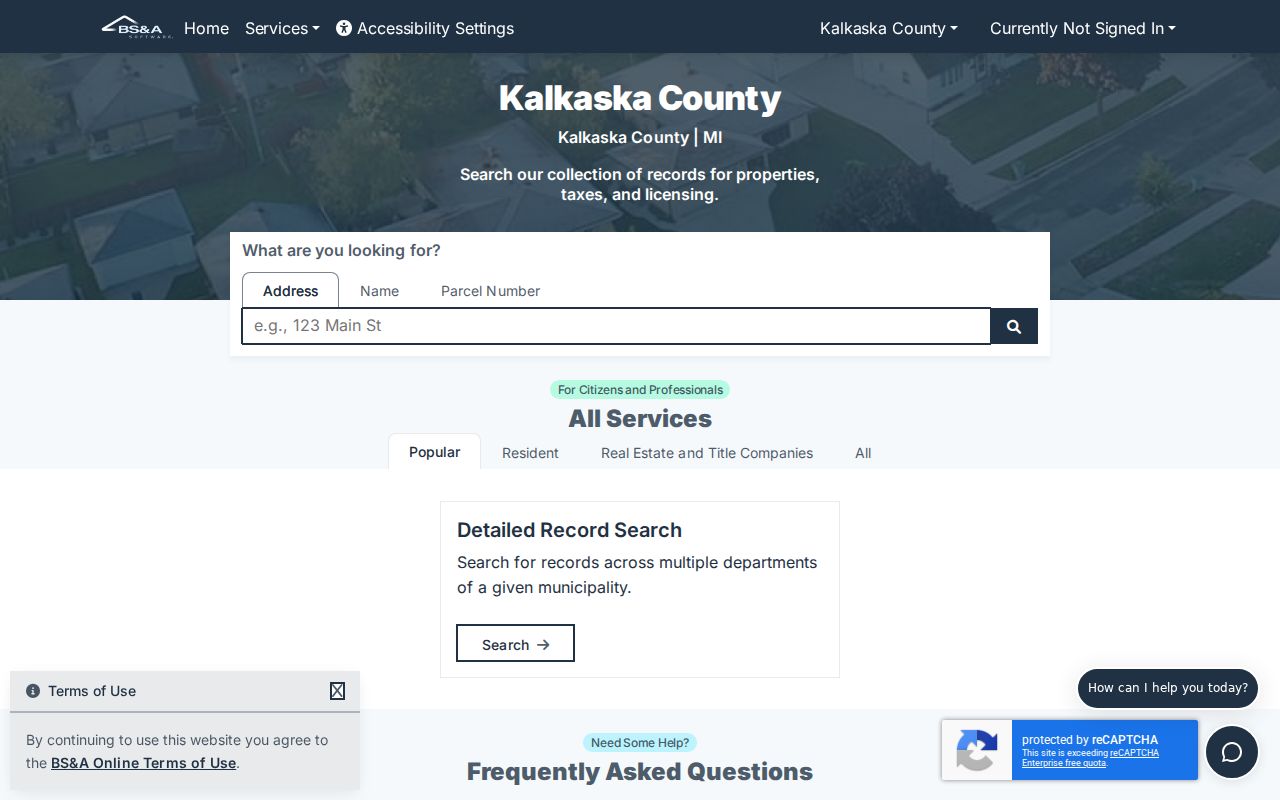
The tiles make a useful point. Assessment, current tax, delinquent tax, and sale searches are related records in Kalkaska County, but each answers a different question, so match the search to the record you actually need.
Trace a Kalkaska Tax Bill
Start with the parcel number whenever you can. It moves cleanly between the Kalkaska County assessor, BS&A, and the Treasurer, where a street address can trip up a match. An address still works, though. Copy it exactly as the assessment card shows it. For calendars, delinquency, foreclosure, millage, exemptions, forms, and payment routing, the Treasurer page is the local authority on any Kalkaska tax bill question.
- Open BS&A from the county gateway and choose Current Tax or Delinquent Tax, not the sale search or payment checkout.
- Search the exact address, then copy the returned parcel number, unit, and tax year. Retry with the formatted parcel if the address fails.
- Read the balance and status beside that year. Compare the assessment tab for taxable value and PRE or another exemption.
- For a past-due result, check the Treasurer timeline and ask the office to confirm the present stage before acting.
- Assessed value
- The value placed on the assessment roll, generally one-half of true cash value under Michigan's framework.
- Taxable value
- The capped amount used with applicable tax rates to calculate tax.
- Millage
- A tax rate expressed in mills and applied to taxable value.
- Principal Residence Exemption
- PRE is an exemption status that may reduce certain school operating taxes when legal requirements are met.
- Tax lien
- A legal claim tied to unpaid property taxes, distinct from a mere current bill.
Save a copy of any result with its date. A payment receipt, a delinquent notice, a judgment, and a foreclosure deed mark separate stages of the same Kalkaska County tax story. Each label matters, so never swap one for another.
Kalkaska Payment Page Limit
The GovPros link in the tax process is a checkout screen, not a parcel database. It collects a payment type, payer and billing contacts, the amount, card or eCheck details, and acceptance of terms. A service fee applies too. Nothing on the form proves a balance is correct, that a parcel was matched, or that the payment landed on the right tax year. That distinction shows plainly on the official Kalkaska delinquent-tax payment form.
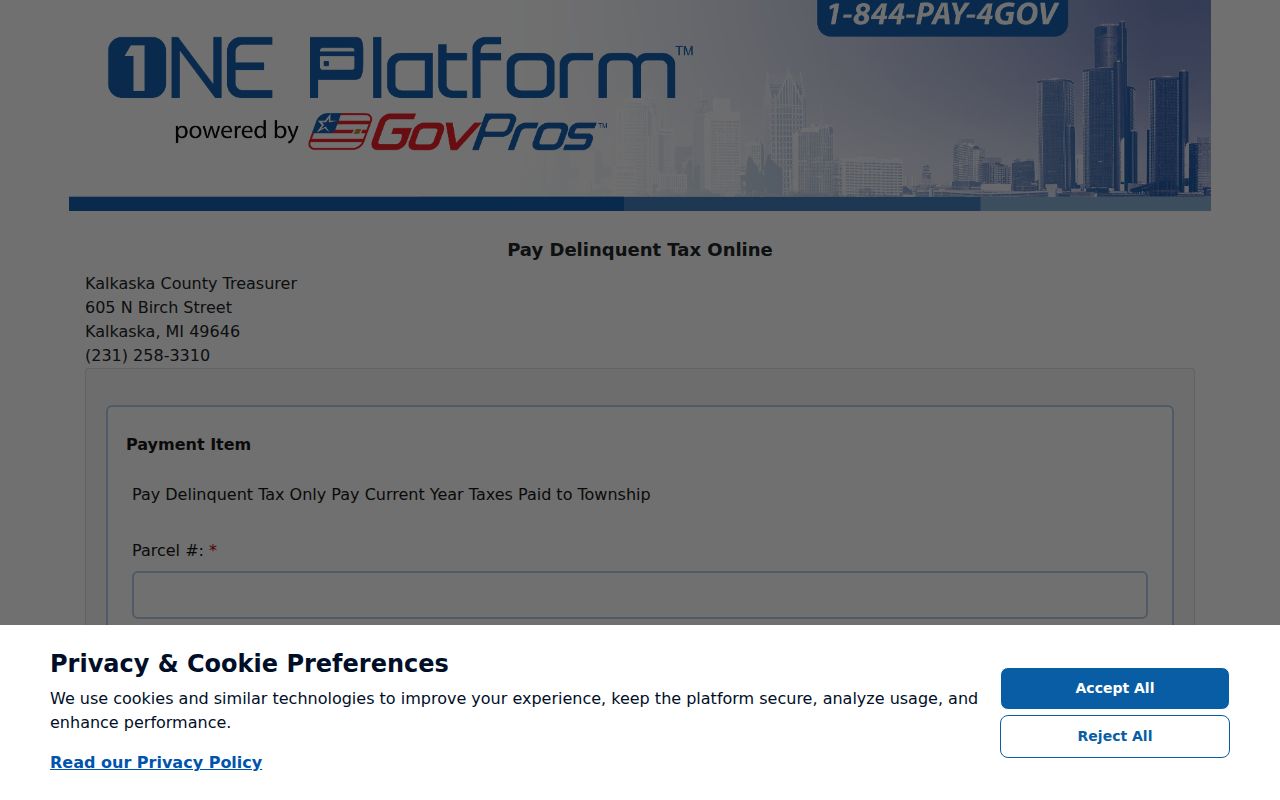
Verify the parcel balance first. Then pay through the route the Treasurer confirms. Never put account, card, or bank data in a records request.
Note: A payment screen cannot confirm a parcel balance or replace a dated current-tax or delinquent-tax record.
Kalkaska Tax Office Roles
One Kalkaska County parcel can touch three separate assessment and tax layers. The township or village assessor keeps the local inputs. County Equalization handles assessment standards, mapping, forms, and countywide equalization, while the County Treasurer collects taxes and administers delinquency and foreclosure material. Sending a tax-balance question to Equalization, or a parcel-value error to the payment vendor, only slows the answer down.
County Equalization
605 N Birch Street, Kalkaska. Call 231-258-3340 for county assessment, GIS, address, and local-assessor routing.
County Treasurer
Use the Treasurer gateway for current or delinquent tax, foreclosure, millage, calendars, and forms. Call 231-258-3310.
The Treasurer link below matters because it preserves the local starting point, not a private listing or an old notice.
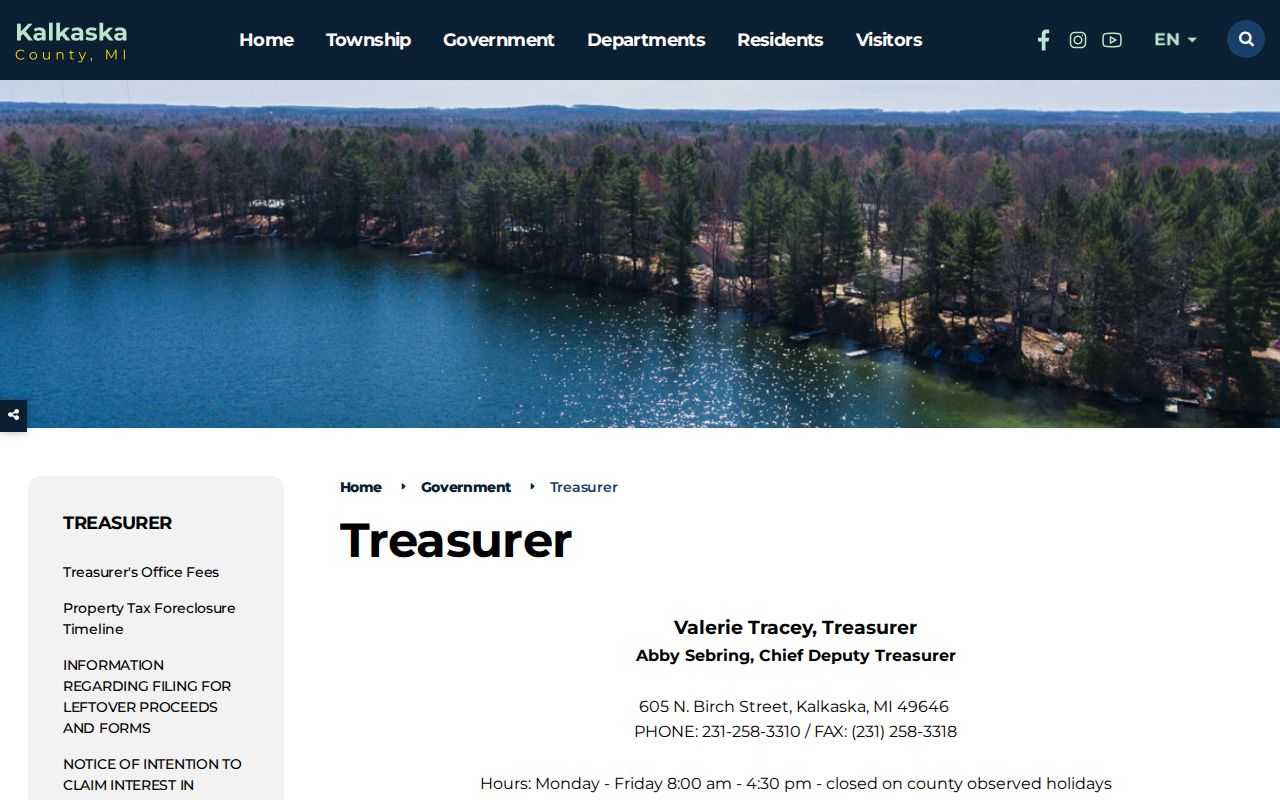
Verify the Kalkaska County tax office foreclosure timeline, forms, and tax details whenever a deadline or amount is at stake.
Kalkaska Tax Exemption Records
An exemption attaches to a parcel and one assessment year. A label on an old card means little today. Never carry it forward without review. Treasurer and Equalization pages route forms for PRE, veterans, forest property, deferment, and other assessment matters. The local assessor decides many parcel-level entries. Keep the application, supporting record, decision, and roll display as separate evidence. Each one answers a different question about the parcel.
Check the years on both sides of a transfer. Michigan's taxable-value rules can uncap value in the calendar year after a transfer. That happens unless an exclusion applies. An exemption change is not the same thing as an uncapping event. Two records can move at once. Record the class, PRE percentage or exemption label, AV or SEV, taxable value, and any decision date. Then explain why the tax bill changed.
Note: An exemption form proves an application was made; the dated assessment roll or decision shows whether the status was granted.
Kalkaska Delinquent Tax Stages
A past-due tax generates records stage by stage. The trail can include a delinquent balance, notice, certificate or judgment, redemption entry, vesting or foreclosure instrument, sale record, and leftover-proceeds form. Label each record by stage and date. A delinquent listing is not a buyable parcel. A legal notice is a lead, not a completed deed.
The 2026 state property-tax calendar ties March 31, 2026 to payment of 2024 delinquent taxes before foreclosure vesting. That deadline is time-sensitive. Confirm it with the Treasurer against the current county calendar. A newspaper notice can help locate a parcel number, legal description, and document number. But the Treasurer's status record and the recorded instrument are the stronger checks. Use them on any delinquent tax.
Check the stage. Verify a delinquent balance, redemption deadline, and foreclosure status directly with the Kalkaska County Treasurer before relying on any static date or notice.
Contest a Kalkaska Assessment
Start with the local unit's assessment notice. Its Board of Review instructions come with it. The state calendar sets the March Board of Review to begin March 9, 2026, but the exact meeting, filing method, and deadline for a Kalkaska County parcel depend on the responsible local unit. Use the current L-4035 or L-4400 instructions. Don't trust a prior year's notice.
Good evidence ties to the parcel and tax year. Gather the assessment notice, record card, legal description, land and improvement entries, class, exemption status, photographs, measurements, and qualified sale evidence. A forced sale or tax foreclosure is not an ordinary comparable. Michigan law defines true cash value through usual selling price. It treats auction and forced-sale context with care.
Protect the appeal window. Confirm the local Board of Review date and filing rules at once; a statewide calendar does not replace the unit's current notice.
Request Kalkaska Tax Records Offline
BS&A does not expose every year or document. Call the Treasurer or local assessor first. Ask whether it can be inspected, mailed, or emailed. Historical assessment rolls, full foreclosure packets, tax-sale reports, and older notices may never appear in a public search. Michigan's FOIA procedure adds another route, letting a written request go by letter, fax, email, or in person.
A focused request names the parcel, raw address, owner or taxpayer label, exact tax years, record type, and preferred delivery format. Ask for records that already exist. Examples include a delinquent parcel list, foreclosure notice, leftover-proceeds register, calendar, or assessment record. The county will not draft a title report. It will not decide a legal question either. Request an itemized fee estimate when production will cost more than you are prepared to pay.
These fallback channels matter in Kalkaska County. Online screens, payment forms, and local office files do not all hold the same tax material. Treat phone guidance as routing only. Follow it with a dated copy or written response whenever the property records result will be cited.